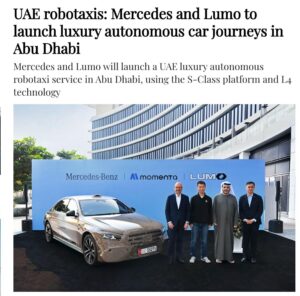

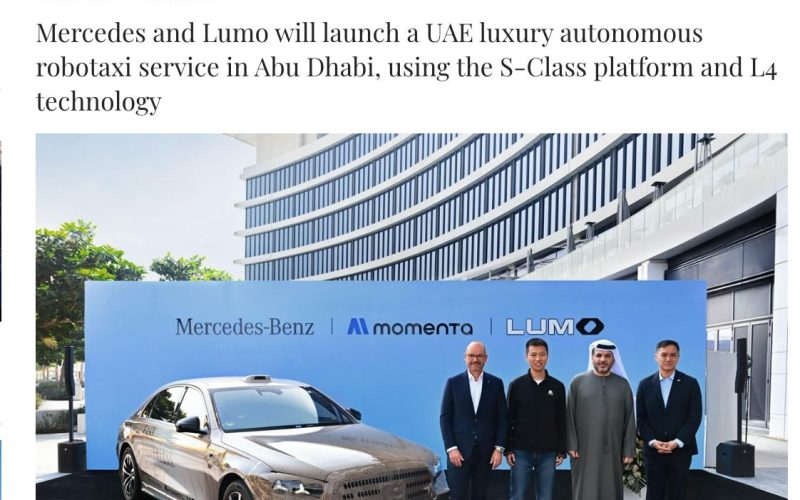
Forget everything you thought you knew about what makes a property valuable. While investors obsess over square footage and finishes, a seismic shift is rolling silently into Abu Dhabi’s streets. The government’s announcement of a fleet of Mercedes-Benz S-Class robotaxis launching in 2026 isn’t just a tech upgrade—it’s a direct, billion-dirham investment in redefining “location, location, location” for the 21st century.
This move, following the successful deployment of basic autonomous shuttles on Yas and Saadiyat Islands, marks a decisive leap from testing a utility to curating an experience. It’s a signal that the future of urban mobility here isn’t merely autonomous; it’s autonomously luxurious.
The “Invisible Amenity” That Will Drive Property Values
Historically, real estate value has been tethered to physical infrastructure: proximity to a metro station, walkability to a mall, ease of highway access. Abu Dhabi is strategically building a new layer of value: seamless, premium, on-demand connectivity.
A fleet of luxury autonomous vehicles fundamentally changes the calculus for a homeowner or tenant:
The End of the “Transit Desert”: A property no longer needs to be within a 10-minute walk of a fixed metro line to be considered optimally connected. A premium robotaxi, summoned in minutes, becomes a personalized, private transit node. This dramatically expands the “prime” catchment area for any major business district, cultural hub, or airport.
The “Time Luxury” Dividend: For the high-net-worth individual, time is the ultimate currency. The ability to work, relax, or take a call in a quiet, luxurious S-Class cabin while being chauffeured across the city is a tangible lifestyle upgrade. This service isn’t competing with buses; it’s competing with the hassle and cost of owning a luxury car and a full-time driver.
The Safety & Consistency Premium: A government-backed, premium autonomous fleet offers a level of predictable safety, cleanliness, and service reliability that even the best traditional ride-hailing services struggle to guarantee. This reduces a major friction point of urban living, making the city more attractive to global talent and their families.
Decoding the 2026 Launch: A Phased Strategy for Dominance
The roadmap is clear and intentional:
Phase 1 (Now): Prove the Tech & Build Trust. The existing network of simpler robotaxis on Yas Island, Saadiyat, and Al Reem Island serves as a live public laboratory. It acclimates residents and visitors to the technology in controlled, high-profile environments.
Phase 2 (2026): Introduce the Premium Tier. Launching the Mercedes S-Class fleet establishes Abu Dhabi not just as an adopter, but as the global leader in high-end autonomous mobility. It targets the exact demographic—affluent professionals, executives, and tourists—that the city’s luxury real estate market relies on.
The Ultimate Goal: Weave a City-Wide Fabric. The eventual integration of these services into a single, intelligent network (hinted at with the Uber and TXAI apps) will make premium, point-to-point mobility a ubiquitous city utility, like water or electricity.
Real Estate Implications: The New “Smart Mobility” Premium
This initiative will begin to crystallize a “Smart Mobility Premium” for properties, particularly in two key areas:
Within the “Robotaxi Ready” Zones: Districts like Al Maryah Island, Saadiyat Island, and Al Reem Island that are first to be integrated into this premium network will see their connectivity advantage solidified. Their value proposition shifts from “great island living” to “great island living with instant, luxury city-wide access.”
In Emerging Master-Planned Communities: For new developments, the promise of being included in this network from day one will become a powerful sales tool. It allows developers to market a futuristic, connected lifestyle that is actually deliverable, not just conceptual.
The Strategic Genius: Solving the “Last-Mile” Problem at the Highest Level
Every major city struggles with the “last-mile” problem—the final leg of a journey from a transit hub to home. Abu Dhabi’s answer is characteristically ambitious: skip the intermediate hub altogether. By making the premium, autonomous vehicle the primary mode for medium-length trips, they are future-proofing the city against congestion and making car ownership less of a necessity. This has profound long-term implications for urban design, parking requirements, and quality of life.
The Bottom Line
The 2026 Mercedes robotaxi launch is not a transportation story. It is an urban strategy story with direct real estate consequences. It represents Abu Dhabi’s commitment to building the most sophisticated, frictionless urban experience on the planet.
For investors and homeowners, it adds a new, critical metric to property evaluation: Is this asset plugged into the city’s premium mobility nervous system? In the coming years, the answer to that question may be as important as the view from the balcony.
Understanding how autonomous mobility networks will reshape Abu Dhabi’s real estate value map requires forward-looking analysis. Our latest report identifies the districts with the highest “Smart Connectivity Upside.”
👉 Download the Insight Brief: “The Autonomous City: Mapping Abu Dhabi’s Next Property Value Drivers”