
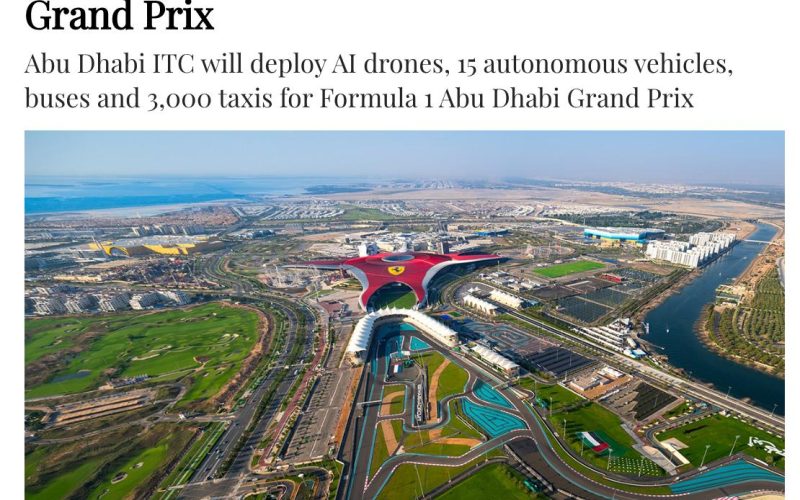
While the world watches to see which driver will clinch the 2025 Formula 1 World Championship this weekend at Yas Marina, a far more consequential competition is unfolding off the track. Abu Dhabi isn’t just hosting a global sporting spectacle; it’s using the intense pressure of the Grand Prix to publicly beta-test the future of urban mobility.
The deployment of an AI-powered traffic management army—drones, autonomous shuttles, and a fleet of over 30 self-driving taxis—isn’t just a clever logistical solution. It’s a high-stakes, real-world demonstration with a captive audience of hundreds of thousands of global visitors, tech executives, and investors. This weekend, Yas Island transforms from a racetrack into the world’s most dynamic smart city laboratory.
Decoding the “Intelligent Mobility” Playbook
Abu Dhabi’s strategy for the Grand Prix reveals a sophisticated, multi-layered approach to solving the universal urban challenge of moving massive crowds efficiently. Let’s break down what each element signals:
1. The AI Drone Fleet: The “God’s-Eye View” Enforcer
-
The Tech: Drones providing real-time traffic flow analysis and automated violation detection.
-
The Real-World Signal: This goes beyond traffic management. It’s a live showcase of predictive analytics and automated enforcement. For a city planning future districts, this proves the ability to monitor infrastructure, manage security, and optimize logistics from the sky, reducing the need for physical patrols and reactive measures. It’s a powerful sell for public safety and operational efficiency.
2. The Autonomous Vehicle (AV) Network: The “Last-Mile” Solution
-
The Tech: Self-driving shuttles on Yas Island and an expanded robotaxi fleet via TXAI and Uber.
-
The Real-World Signal: Abu Dhabi is solving the most expensive and complex piece of the transportation puzzle: the last mile. By proving AVs can safely and effectively move people between hotels, venues, and attractions during one of the planet’s most congested events, they build immense public trust.
This isn’t a closed-campus trial; it’s an open, complex environment under global scrutiny. Success here accelerates the timeline for mainstream AV integration in new developments like Saadiyat Island and Reem Island.
3. The 3,000+ Taxi Fleet: The Integrated Backbone
-
The Tech: A massively scaled traditional ride-hailing network, intelligently dispatched.
-
The Real-World Signal: The government understands that the future is hybrid and integrated. The vision isn’t an immediate, jarring shift to full autonomy, but a seamless blend where AI coordinates all modes of transport—from self-driving shuttles to traditional taxis—into a single, efficient system. This pragmatic approach reduces disruption and showcases holistic planning.
The Ripple Effect: Why Real Estate Investors Should Watch the Parking Lot
This isn’t just a transportation story. The successful deployment of these technologies has direct and powerful implications for Abu Dhabi’s real estate value proposition.
1. The “Smart City” Premium Becomes Tangible
Developments can now be marketed not with promises of future tech, but with proven, stress-tested systems. A residential tower in a district served by these intelligent mobility solutions can legitimately claim a higher “future-proof” premium. It appeals directly to a tech-forward demographic seeking convenience and innovation.
2. Unlocking Development Potential
Efficient, AI-optimized transport reduces the need for vast swathes of land to be dedicated to parking and wide roads.
This allows master developers to re-allocate space to higher-value uses: more parks, wider pedestrian promenades, additional residential plots, or leisure facilities. This increases the density and quality of life within communities, directly boosting land values.
3. Enhancing the Global Brand for Talent & Capital
A city that moves people this smoothly during an F1 race sends a unequivocal message to multinational corporations and skilled expatriates: “We are competent, innovative, and focused on quality of life.”
This strengthens Abu Dhabi’s position against regional competitors, driving demand for both commercial office space and high-end residential units from companies and the talent they attract.
The Checkered Flag: What’s Next After the Podium?
When the champagne spray settles on Sunday, Abu Dhabi’s victory won’t just belong to a racing team. If the intelligent mobility systems perform as intended, the city will have achieved a crucial win in public perception and technological validation.
The Grand Prix weekend is the ultimate proof of concept. The real race now is to scale these solutions from the controlled environment of Yas Island to the broader cityscape. The districts that integrate these proven technologies first will set a new benchmark for urban living in the region.
For investors, the signal is clear: the long-term value of a property in Abu Dhabi is increasingly tied not just to its view or finishings, but to its connectivity within a smarter, smoother, and more responsive urban ecosystem. This weekend, that ecosystem is being tested at full throttle.