
The release of Dubai’s January real estate transaction data is not just a monthly report; it is a statistical exclamation point that demands a fundamental reassessment of the market’s scale, drivers, and trajectory.
The numbers—Dh107.96 billion in total transactions, Dh70.05 billion in sales value, and 16,858 sales deals—are not merely records; they are phenomena that crystallize the profound structural shift underway in the emirate’s property landscape.
This analysis moves beyond the staggering percentages to explore the underlying forces, the shifting geographic frontiers, and the long-term implications of this explosive start to the year.
Decoding the Numbers: A Market in Hyper-Growth
The year-on-year increases are so substantial—86.5% in total value, 59.13% in sales value—that they transcend normal cyclical recovery or seasonal uplift. They indicate a market operating at a new velocity. To put the Dh70.05 billion monthly sales figure in perspective, it rivals the quarterly sales volumes of just a few years ago.
This leap suggests a confluence of factors: not just increased activity, but significantly higher transaction values per deal, pointing to a market heavily weighted toward premium and super-prime segments.
The composition of the Dh107.96 billion total is equally telling. Sales (Dh70.05bn) and mortgages (Dh32.04bn) together account for over 94% of the activity, illustrating a market powered by both outright purchases and leveraged acquisitions.
The robust mortgage volume indicates deep participation from the banking sector, providing the liquidity to underpin this expansion, while the substantial “gifts” category (Dh5.87bn) highlights the maturation of the market as a vehicle for intergenerational wealth transfer and asset structuring.
Geographic Re-Mapping: The Rise of New Frontiers
The list of top-performing areas is perhaps the most revealing data point for strategic observers. The dominance of Al Rowaiyah 1 (Dh6.31bn) and Meydan 2 (Me’aisem 2) (Dh6.04bn) signals a powerful and sustained southward expansion of Dubai’s high-value residential corridor.
These are not traditionally historic prime areas, but new master-planned communities offering larger plots, villa living, and modern infrastructure. Their prominence reflects a buyer preference for space, community living, and access to emerging hubs like Dubai Hills Estate and the proximity to the Expo City Dubai corridor.
Similarly, the strong showing of Al Yalayis 1 (Dh4.6bn) and Palm Jebel Ali (exceeding Dh1.7bn) underscores the aggressive and successful development of Dubai’s western waterfront frontiers. These areas represent the next generation of coastal living, attracting capital that previously might have concentrated on the Palm Jumeirah or Dubai Marina.
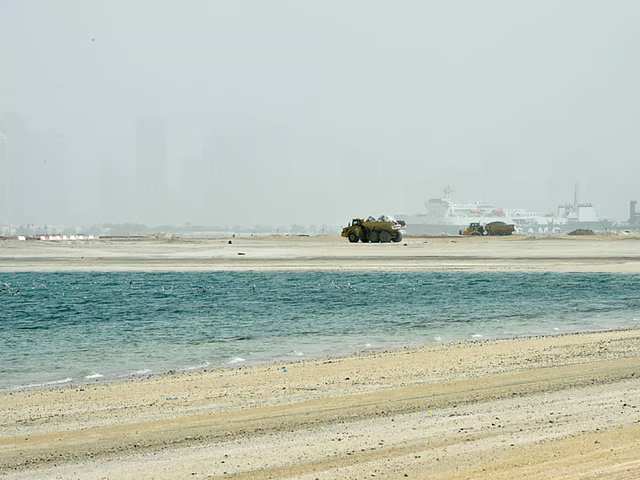
The inclusion of Palm Deira in the top ten further reinforces that investor confidence is locked onto the long-term vision of the Dubai Islands development, even in its early stages.
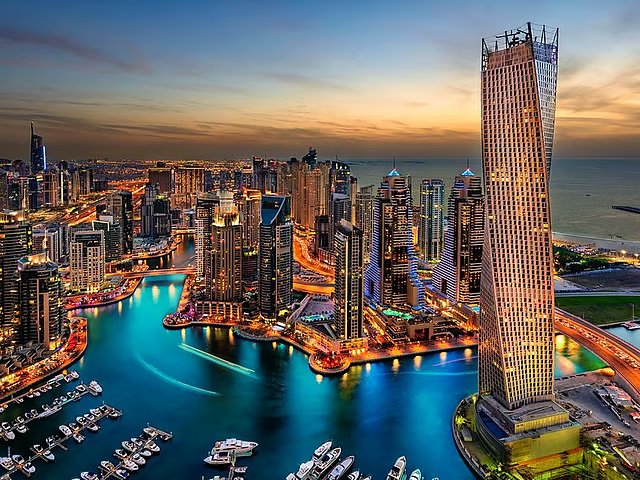
The presence of Business Bay (Dh3.51bn) acts as a crucial counterbalance, confirming that the established urban core continues to attract massive investment, likely in high-rise residential and commercial assets.
This geographic spread—from established downtown cores to emerging southern suburbs and new western coasts—paints a picture of a market growing omnidirectionally, with multiple, simultaneous gravity centers of investment.
The Core Driver: The “Permanent Destination” Thesis
Ahmed Al Dawla’s commentary cuts to the heart of the narrative shift. Dubai’s evolution from a “temporary stop” to a “city of long-term residence” is the central thesis explaining these numbers. This is a demographic and psychographic transformation, not just a real estate cycle. Key pillars support this:
-
Policy Anchors:Â Long-term residency visas (Golden Visas, retirement visas), full foreign ownership laws, and a transparent regulatory environment have systematically dismantled the barriers to permanent settlement.
-
Economic Diversification:Â The growth of sectors like fintech, venture capital, logistics, and family office services creates high-value, stable employment that anchors professionals and entrepreneurs.
-
Safe-Haven Status: In a region and a world marked by instability, Dubai’s safety, social tolerance, and geopolitical neutrality have made it a premier destination for global capital and talent seeking a secure base.
This shift from transactional, investment-driven buying to end-user-driven, residence-focused acquisition creates a more resilient demand base.
People buying to live, raise families, and build lives contribute to community formation and create inelastic demand for services, schooling, and retail—further fueling a positive economic feedback loop.
Supply, Demand, and the Trillion-Dirham Horizon
Al Dawla’s observation that 2025’s transactions approached a Dh917 billion target originally set for 2033 is staggering. It implies the market is running nearly a decade ahead of its own most ambitious forecasts.
His projection of a soon-to-be-surpassed Dh1 trillion annual trading value suggests we are witnessing the maturation of one of the world’s most liquid real estate markets.
This velocity is colliding with the fundamental constraint of limited land availability in desirable, serviced locations. The record Dh11.1 billion land mortgage discussed earlier is a direct symptom of this: developers are paying a premium to secure the last large, prime tracts.
This supply constraint, against a backdrop of seemingly insatiable and deepening demand, creates powerful upward pressure on prices, particularly for completed, ready-to-occupy properties in well-established or emerging master-planned communities.
Conclusion: A New Paradigm, Not a Peak
Interpreting January’ figures as a market “peak” would be a misreading. They are better understood as the first clear data points of a new paradigm.
Dubai’s real estate market is being fundamentally resized and repriced in line with its repositioning on the global stage. It is transitioning from a volatile, speculation-influenced market to a deep, liquid, and fundamentally driven one, attracting permanent capital from a global citizenry.
The risks—global economic headwinds, interest rate environments, and the management of construction quality and infrastructure pace—remain. However, the January data demonstrates that the underlying demand driver has changed. It is no longer purely cyclical or speculative; it is demographic and structural. The record-breaking numbers are not the sound of a bubble inflating, but the measurable output of a city successfully executing a long-term strategy to become a primary home for the world. The momentum is now built into the city’s very identity, suggesting that while month-to-month figures may fluctuate, the directional trajectory toward a larger, deeper, and more resilient market is firmly established.